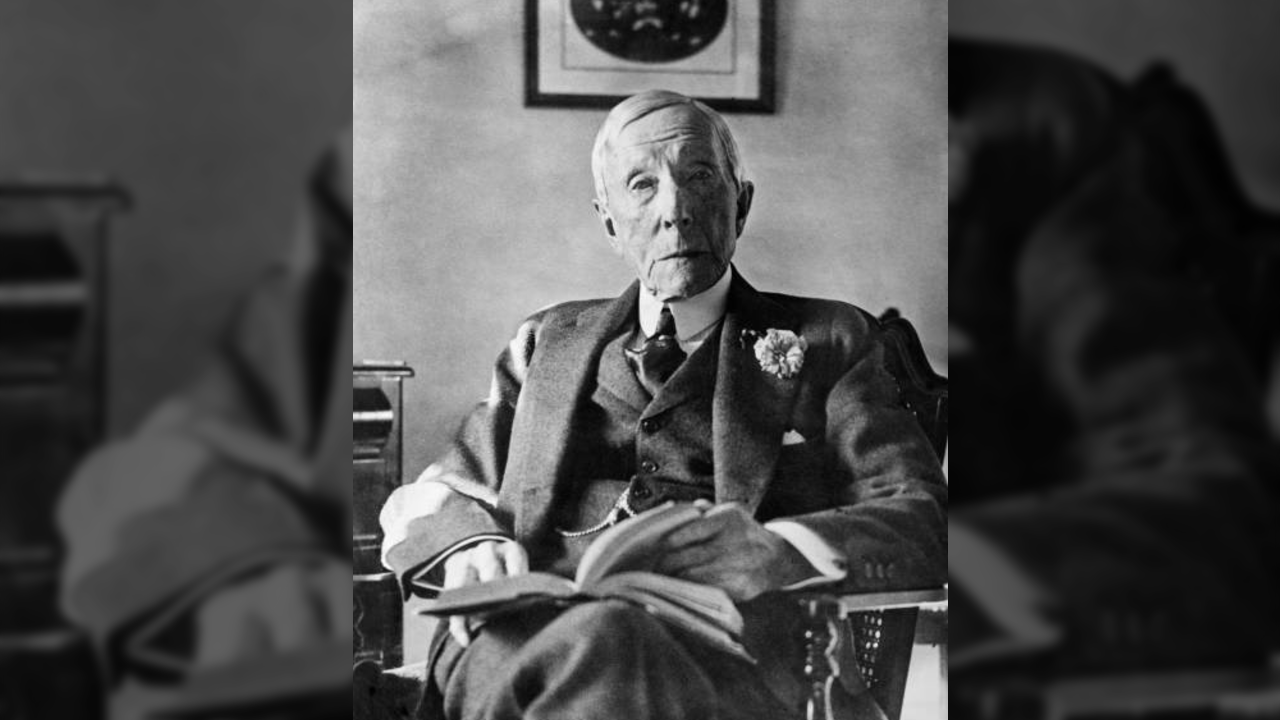
In 1872, in Cleveland, Ohio, 23 companies — 18 of them oil refineries — found themselves in the hands of one man, John D. Rockefeller, in less than a month. There was no bankruptcy, no price wars, no auction and no dramatic showdown. By the time most of Cleveland understood what was happening, it was already too late.
These company owners were not fools; they were competent and survived years of real competition. So what caused them to hand over what they built in less than a month, without a fight?
Oh and the thing that scared them into selling? It hadn’t actually happened yet. It never would.
The mechanism of the threat
Let’s go back a few weeks to where it all began. It’s January 1872 and Rockefeller and a small circle of his allies just struck a deal with three of the country’s biggest railroads.
On paper it was called the South Improvement Company. In practice, it structurally destroyed any possibility of competition.
Here’s how the mechanism works:
Standard Oil got a rebate (a partial refund) on every barrel it shipped. This was in fact nothing out of the ordinary. Big customers often got better discounts than smaller ones. However, the agreement did not stop there.
Standard Oil also collected a cut every time the railroad shipped a rival‘s oil. This is known as a drawback, and it effectively means that his rival’s business funded his own business.
This was Rockefeller’s game, and just imagine how devastating it must be for his rivals to play it. No matter how efficient your business is, how good your oil is or how hard you work, ultimately you are helping the very man who seeks to destroy you.
But Rockefeller, in his extreme benevolence, offered a way out. Let him buy your company and you are no longer a rival. Then the agreement wouldn’t apply to you. So what could his rivals do?
He didn’t even need to lift a finger. No need to monitor the market, decide who to punish, or spend his resources on a price war. Once the agreement was signed, the railroad’s own accounting did the damage.
This was what made the threat so formidable. It wasn’t a simple empty threat, where someone announces something scary. It was effective precisely because Rockefeller cut off his ability to not follow through with the deal.
His strategy is like that of a general burning his ships so that his soldiers would rather die than escape.
Rockefeller burnt his ships, and his rivals now very well knew that he wasn’t bluffing.
Is there a way out?
Even the most intricate problems have their solutions, and this problem was no exception. The scenario I have presented to you here is the problem of “belling the cat.”
If these 18 refineries had stood together and refused to sell, they could have out-negotiated Rockefeller (or at the very least, made it expensive enough for the agreement to be rendered meaningless). They did not, and therein lie all the reasons for defeat.
Let me show you how to look at this with an example:
Imagine a landlord who has just bought an apartment. Now legally he has the right to evict only one person from the building, so that he can live there too.
But who wouldn’t want a whole apartment to themselves? So the landlord approaches each of the tenants one by one and offers them a payout for leaving. The tenants can either be paid to leave or be evicted without one.
If every tenant refused and stood together, he would be stuck with one lonely eviction, and that would be the end of it. But no tenant can be sure others would hold the line, and if you were the one person still holding on, you would lose your home for nothing while everyone else would leave with a wad of cash.
This game is similar to the prisoner’s dilemma, but the difference is that it is played by a group rather than individually.
This was the game the Cleveland refiners were playing against Rockefeller. He wasn’t threatening the whole group; he was making offers to individuals which basically amounted to: Sell now, on decent terms before my agreement makes your business worthless anyway.
A month later, all 18 refineries were in the hands of Rockefeller.
The exception
However, the Cleveland refiners were not the only people to feel the threat’s embrace. A hundred miles east, in the oil fields of northwestern Pennsylvania, a different group was staring down at the exact same problem.
The same railroads and the exact same rate hikes. And they did the opposite of what Cleveland did. The crude oil producers of the Oil Regions organized fast, forming the Petroleum Producers’ Union.
This was not a mere fairytale alliance either. To make sure no one backed out, they had men checking for anyone breaking ranks. If someone did, their firm was blacklisted and trade with that company was banned.
Within weeks, the refineries connected to the scheme couldn’t get any crude oil at any price from anyone. The railroads connected to Rockefeller, now cut off from the freight that had been their livelihood, folded under the pressure.
They canceled the previous agreement with the South Improvement Company and cut a new deal with the Petroleum Producers’ Union.
And the final nail in the coffin, in April 1872, less than three months after it was signed, Pennsylvania revoked the South Improvement Company’s charter.
So what’s the lesson to be learnt from all this? You might hop off this blog post thinking it is about teamwork. You need allies to defend against a strategy, and you need allies for an effective strategy.
But here’s the twist. The Petroleum Producers’ Union didn’t last forever either. Years down the line, that very alliance came apart on its own, and Rockefeller, completely unbothered, went right back to doing quietly what the South Improvement Company had tried to do loudly. Within a decade, he controlled almost all of American oil anyway.
So teamwork alone isn’t the lesson. If it were, the producers’ alliance should have held forever, and it didn’t. The real lifeline lies in the bond of the alliance itself. An alliance only survives if no one inside it can quietly break away without everyone else finding out. If you cannot actually trust the people standing beside you, you will find yourself falling for a strategy just like this one, alone.
Thank you for taking your time to read my post! I hope you learnt something new and if you have any other scenarios on Game theory just like this one, write it down in the comments. I will be happy to hear from you!