When you arrive in a new country, drained and tired, immigration feels like a hassle. With long queues and sluggish systems, it would be a miracle to move through immigration easily.
Singapore integrated this miracle into its very systems. When we arrived, immigration merely presented us with sleek e-counters, with no immigration officers in sight. We simply scanned our passports (and our faces) and we were done.
Such is the beauty of Singapore’s frictionless system, designed purely to push away any obstacles to tourism. This deep interest in maximizing tourism can also be seen elsewhere.
Our driver and guide for the first day was the one who mentioned it first. He was showing us around Singapore, giving us a short history lesson, when he mentioned an interesting fact. Singapore’s area had gone from 500 square kilometers all the way to 700 square kilometers in 20 years.
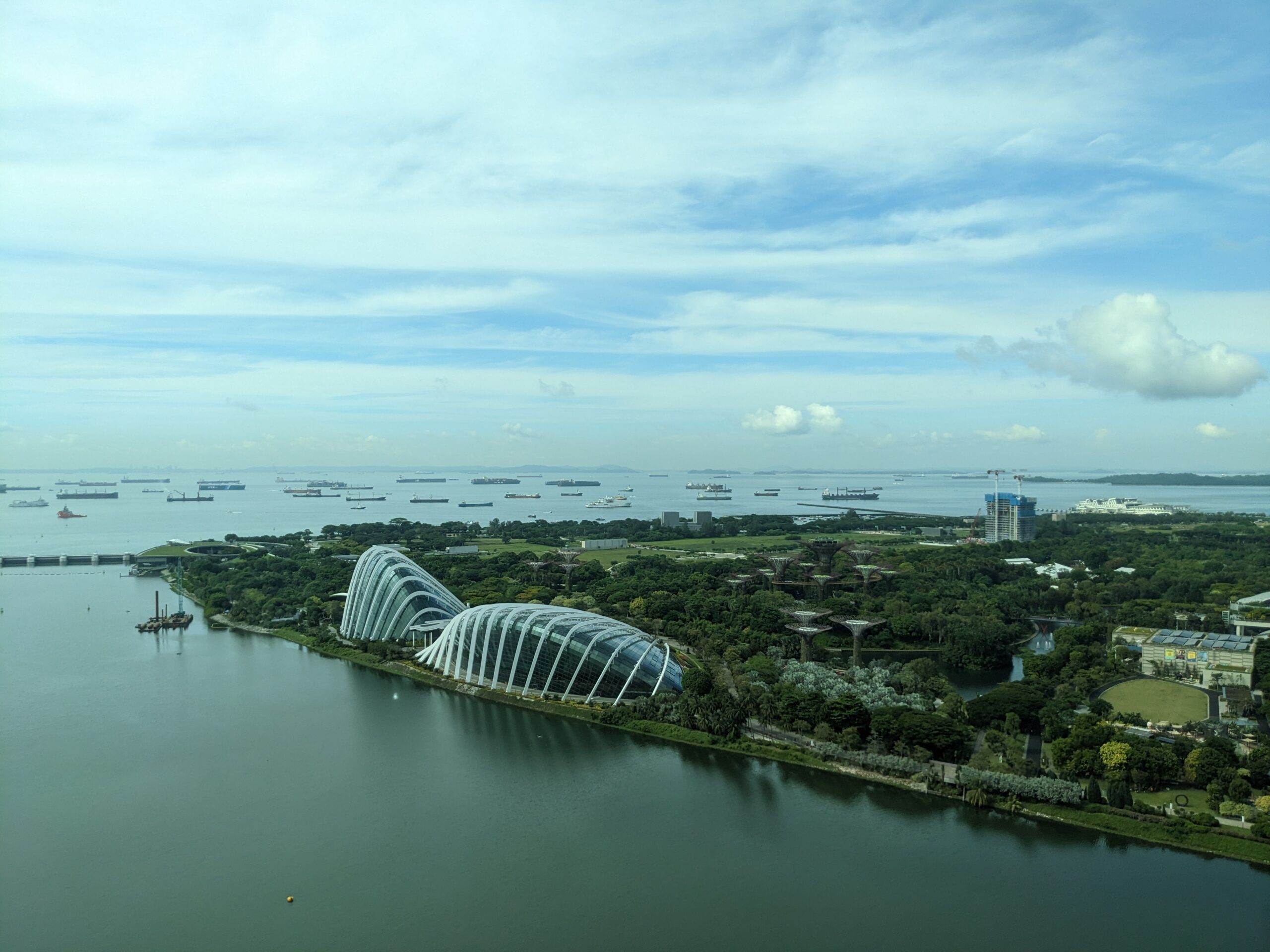
The country was actively reclaiming its land from the sea, and the result of its efforts is what birthed Marina Bay, where Gardens by the Bay currently exists.
The effects of increased tourism
The idea to increase tourism is in fact quite ingenious. The primary effect is obvious: by increasing tourism, Singapore creates a huge number of jobs in the tourism industry. But its silent effects are just as pronounced.
Think about what a citizen or permanent resident of Singapore costs the government over a lifetime. Education, subsidized healthcare, retirement support, public housing subsidies, etc.
Now compare that to the costs the government faces for tourists. None of the costs for citizens apply.
And in the short amount of time the tourist remains in Singapore, he or she will spend on hotels, food, attractions, and travel. Every activity of the tourist has a price, and the government directly benefits.
This leverage has a real name in economics too: it’s about managing who bears the long-term fiscal liability and who captures the short-term fiscal benefit, and that makes all the difference.
This is a great benefit for a small, resource-poor state. Singapore cannot grow itself fast enough to be solely funded through its citizens. Therefore, the country imports the economic activity without importing the social cost.
The numbers solidify this observation: the average tourist spends roughly $1800–1900 per trip, and in 2024, approximately 16.5 million visitors arrived in Singapore.
This results in 570,000 jobs being supported solely through tourism, which is roughly 14.2% of total employment (as of 2024). And finally, this all converges into one single data point: Singapore’s tourism equates to 10.1% of its GDP.
Let’s talk business
This ease of tourism can be similarly applied to business. Singapore ranks #2 globally in ease of doing business. This easy, low-friction regulation drastically decreases the cost of trying.
See, every multinational or founder is weighing the setup cost, the compliance burdens and the predictability of setting up a business.
When Singapore decreases the friction at all of these points, it does not simply attract one business. It attracts a hoard of businesses.
On the first day, we went on the Singapore Flyer. The timing was perfect, of course, to see the view high above Singapore before touring it in detail.
The view was amazing; on one side a big blue ocean and on the other a sea of skylines. But if you closely scrutinize these buildings, you will find the names of large banks etched upon them. It was a skyline of banks, a mountain range of literal money.
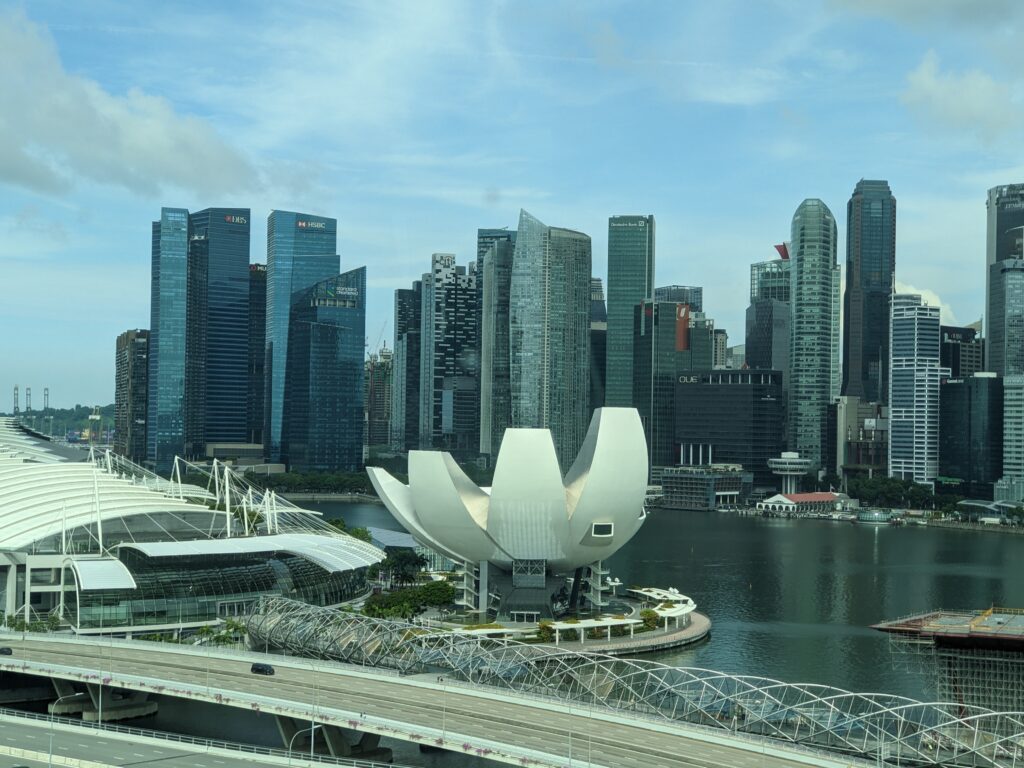
Searching up a bit more about this, you will find that Singapore is in fact home to:
- 6 local banks
- 10 foreign Qualifying Full Banks, 20 foreign Full Banks
- ~95 Wholesale banks
- 21 Merchant banks
One bank, the DBS, boasts a record $10.06 billion dollar profit in FY 2023.
This begs an interesting question. What came first, the prestigious banks or the growth of Singapore?
The answer is, in fact, a quiet policy. In the mid-1960s, Singapore did not have the necessary environment to be a financial center. What it did have, however, was a government ready to make a deliberate and strategic move.
In 1968, the authorities of Singapore licensed a branch of Bank of America to set up a special unit in Singapore to handle nonresident transactions.
What supported this policy was a number of small incentives implemented by the government. For example, the government scrapped the 40% withholding tax (known as Tax Deducted at Source in India) that would have originally been charged on the interest paid to nonresidents.
Another example was dropping the corporate tax on the income banks earned from offshore lending from 40% all the way to 10%.
This is what eventually led to more banks deciding to set up their branches in Singapore, creating the ecosystem we see now.
The interesting conclusion
So what do all these observations lead to? Why should you care about this?
If you observe carefully, you will notice that the government is responsible for this growth. Every single tide was first swept up through the small decisions made by the government.
Encouraging tourism, introducing a simple policy, and deciding to host an offshore market; each of these actions cascaded into Singapore’s growth.
And remember, they were all small decisions. Decisions that led to growth resembling a tsunami. Singapore is proof that small, deliberate and strategic decisions lead to huge changes.
If you have even more observations, drop them in the comments and let me know!